The Prequel
“If you had started investing 5 years ago – you wouldn’t be cribbing today” said the finance savvy friend in your social circle as he scrolled through his phone, occasionally giving you glimpses of some recent trades that had been profitable.
Sounds familiar?
We’ve all been there at some point in our life.. Being forced to rethink our life goals, our plan to the point of questioning our mere existence without the alleged investments that this friend has been boasting about.
But then, you step back and wonder – how did he get so lucky? You saved up as well – (albeit in your bank’s current account), you supposedly earn more than that friend as well. So what sorcery has he conjured to have exceeded your life savings within a span of 5 years?
The answer is not some rabbit pulled out of the hat – its math!
Disappointed? Don’t be, because only about 33% of adults (globally) are familiar with this concept and while familiarity with the word is slightly higher, the ability to apply the concept in real life & actually implement it to their benefit is extremely low.
So what’s the word? (drum rolls)
COMPOUNDING!
It’s a single word but means the world to some of the wealthiest individuals today! (Hi Warren)..
Everyone tells you to start investing early..
They’re right!
The problem, though, is that most of the explanations stop right there – dead in their tracks!
“Start early to benefit from compounding” – GREAT!
But what does that actually mean?
Why does investing at 25 look dramatically different from investing at 30 or 35?
The answer is still compounding – a concept so simple that most people claim to understand it in a few minutes.
A concept so powerful that most people spend their entire lives underestimating it.
What Is Compounding? 🌱
Ever heard people say that to make money, you need money? That’s what compounding is – well, sort of.
Put simply, Compounding is what happens when your money earns money and then the money you’ve earned starts earning money too.
Let’s dumb it down a little more – this time with some numbers so everyone can follow.
Suppose you invest $1,000 and earn 10% annually.

Still with me?
Now comes the interesting part!

Notice that your return increased from $100 to $110.
You didn’t invest more money.. You didn’t find a better investment..
Your money simply had a larger base to work from.

The percentage stayed the same @10%, the amount earned increased AGAIN!
That’s compounding!
Your original investment is working – Your previous returns are working too!
The Misconception about Investing 📈
Most people think wealth grows like this:
Year 1: +$1,000
Year 2: +$1,000
Year 3: +$1,000
Year 4: +$1,000
A straight line. Predictable & Neat!
Unfortunately Fortunately, that’s not how wealth grows.
Compounding creates a curve – It starts slowly, painfully slowly.. Till they accelerate!
Then one day, you’re Jack, scratching your head – wondering where this gigantic beanstalk came from!
Let’s take the same $1000 example and stretch the years out..

At first glance, this probably doesn’t look very fancy – or does it?
After 10 years, you’ve gained $1,594 – Not bad eh? But hardly something that convince you just yet.
Now look at what happens later:
Period 0 – 10 years -> $1,594
Period 10 – 20 years -> $4,134
Period 20 – 30 years -> $10,722
The First 10 Years Are Usually The Hardest ⏳
Read that last number again!
The final 10 years produced more wealth than the first 20 years combined!
Same investment, same return, same investor – the only difference?
Time!
This is where many investors make that grave mistake. They quit before compounding starts doing the heavy lifting.
Oh and before you say I’m only gaining $15,449 in a period of 30 years – that’s peanuts? Just increase that “Starting Amount” by 10x or 100x – $100,000 invested in Year 1 would be worth $1.64 million in 30 years.
Think you can save a million any other way? Well – good luck!
The Example Everyone Should See 👥
So much for investing in year 1 and then forgetting about it for the next 30 years – Let’s jump into a real life example and compare 2 investors.
Adam
- Starts investing at the age of 25
- Invests $5,000 per year
- Stops completely when he turns 35
- Let’s this investment grow till he’s 60
- Total Invested: $50,000
Diana
- Starts investing at the age of 35
- Also Invests $5,000 per year
- Continues until the age of 60
- Total invested: $125,000
Let’s assume both invested to earn 10% annually.
Adam invested $50,000 across 10 years and then let it compound for the next 25 years
Diana invested $125,000 across 25 years while they compounded as well
Who do you think ended up on top?
The value of Adam’s investment at 60 was $602,000
The value of Diana’s investment at 60 was $541,000
Wait, what? How can someone investing more than twice the amount end up falling behind?
While all else looks the same – Adam’s investment compounded for 35 years (an additional 10 years) while Diana’s only went up to 25 years.
This is why investing early matters so much – because you can’t earn for the rest of your life and the earlier you start investing – the more time you’re allowing your savings to compound.
Warren Buffett – The Plot Twist 🏆
If you’ve come this far, asking if you recognize this name is going to be an outright insult – so..
The greatest investors of all time? Surely
What you might not know is that Buffett wasn’t born a billionaire. For whatever its worth, he accumulated most of his wealth post the age of 56. And what I’m calling wealth here was his first billion. How?
Now don’t make me repeat the word since that would be an insult too 🙂
If Buffett had started the same investment(s) 20 years later, he would be dramatically less wealthy today (well, that’s not saying much, but you get it).
In his case, skill matters – but time matters more than most people think.
3 Things That Drive Compounding ⚙️
Our quest for overnight success (read as greed) mixed with human psychology naturally makes us question one element of investing – The rate of return.
Why not get a higher return and 10x wealth in less time..
In reality, compounding is driven by 3 variables:
1. Time
The biggest of them all – and the variable most investors have the least respect for.
I’ve mentioned this before and I’ll keep repeating it because this statement has been stuck in my head since I’ve known it. “It’s not about timing the market but the time spent in the market”
Imagine increasing your annual return from 10% to 20%.. Possible? Yes!
But a 10% return would outweigh the returns of that 20% given a larger time frame.
Time quietly does more heavy lifting than almost anything else.
2. Return
Just because I downplayed it doesn’t mean it doesn’t matter – heck, I’d take a bigger return any day (I’m human too)
The only problem? Greed! As soon as we see a bigger return, we become obsessed with squeezing out an extra 1% or 2% while ignoring the bigger picture.
A mediocre strategy followed consistently for decades often beats a brilliant strategy abandoned after 2 years.
There, I said it!
3. Consistency
And it’s obvious that you can’t mention time without consistency.
Most wealth isn’t built through a single brilliant investment.
It’s built through hundreds of boring contributions made over many years. An investor who contributes every month usually beats the investor who waits for the perfect opportunity (Timing the market… there I said it again)
Those chasing perfection often overlook consistency – the real power tool behind compounding and wealth creation.
Inflation – The Silent Enemy Of Compounding – Enter the Antagonist 🎈
If compounding is the protagonist of our story here – Inflation is hands down the antagonist!
Consider it that uninvited neighbor at your close knit party who sneaks in and slowly eats all your food before it’s even served.
Let’s say your investment grows by 10% annually (same example) but news flash – inflation just got introduced in your life at 6%. While your supposed wealth increased by 10%, your purchasing power only grew by 4%.
This is one of the key aspects of looking at what you’re getting into when calculating returns.
How much money you have doesn’t matter – what matters is what that money can actually buy.
Quite the damper isn’t it? Yes? I thought so – don’t worry, I won’t ruin this today.. We’ll discuss inflation and long-term wealth some other day.
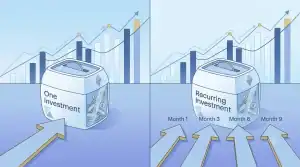
Systematic Investment Plan (SIP) vs Lump Sum Investing 💰
So, you’ve decided to join the party? Congratulations!
Your next and most obvious question might be – “Should I invest all at once and let it compound or spread my investment over time?”
The answer depends on several factors
- Market conditions
- Risk tolerance
- Available capital
I could probably write a separate blog on this topic alone (and why not? That’s exactly what I’ll do) but just to give you a teaser
Market Conditions
If markets have fallen significantly and valuations look attractive – investing a lump sum can often produce better long-term returns because your money starts compounding immediately and benefits from the undervalued market. On the other hand, if markets are volatile, and you’re concerned that a collapse could be around the corner, spreading your investments over several months can reduce the emotional stress of making a large investment all at once.
Risk Tolerance
Some investors can comfortably invest $1 million in a single day and forget about it.. Others invest the same amount and spend the next six months checking their portfolio every hour.
Neither approach is wrong – the best strategy is often the one that helps you stay invested during difficult periods.
P.S: A friend is actually working on the risk aspect side of investing and that is one project I’m really looking forward to – more on that in due course.
Available Capital
This one is quite straightforward. If you receive a bonus, an inheritance or proceeds from selling an asset, you may have a large amount available to invest. But if you’re investing from your monthly salary – it’s not quite the same.
What matters is that both approaches (SIP vs Lump Sum) benefit from compounding – it all boils down to what you prefer and are able to do.
Personal opinion: No matter how much I invest in the month (whether its a SIP or a Lump sum) – I always feel it falls short once I’m done taking exposure.
Time In The Market Beats Timing The Market 🕰️
You started following a new whatsapp group where a self proclaimed technical chart guru claims to know every single dip at the back of his hand – the guru gives an ominous call – an inflection point from which point onwards, the market is going to collapse like a pack of cards. You liquidate all your holdings, hoping to buy at the lowest possible price. And then – the market rallies.
Investors love predicting markets – markets rarely cooperate!
Nobody can surely tell you:
- When the market will peak
- When it will crash
- When the next rally will begin
Many investors sit on the sidelines, waiting for the perfect entry point (For all we know, they’re probably still waiting)
Meanwhile, compounding is sitting on the sidelines, waiting for money to be invested.
So, what did we learn?
The goal isn’t perfection – The goal is PARTICIPATION!
Because compounding only works on money that’s actually invested.
Investment Growth Calculator
Don’t just take my word for it – I know these examples might be useful
But your situation is different, your age is different, your savings rate is different and most importantly, your investment horizon is different!
Instead of relying on generic examples, use the Investment Calculator to see how compounding affects your own portfolio.
You might be surprised how much of the outcome comes down to one simple variable:
Time
Common Compounding Mistakes
Waiting for More Money
A lot of us believe they’ll start investing once they earn more – days become months, months turn to years. Nothing changes.
Start TODAY! Your future self will thank you (and maybe me too)
Chasing Hot Investments
Jumping from one trend to another interrupts compounding. Wealth is usually built by staying invested, not constantly moving money around. Don’t become a part of the rat race.
Stopping Contributions
Compounding works best when fresh capital continues entering the system. Consistency is King!
Focusing only on returns
Investors love discussing percentages. Few discuss behavior. Yet behavior often determines outcomes more than returns do.
The Rule Of 72: The Fastest Way To Estimate Growth 🧮
Here’s one of my favorite tricks that investors typically use.
It’s called the Rule of 72
Take the number 72 and divide it by your expected annual return.
The result tells you roughly how many years it takes for your money to double.
Let’s say you earn 12% annually.
72 ÷ 12 = 6
That means your money roughly doubles every 6 years.
This is why investors become obsessed with time. Every additional doubling cycle changes the outcome dramatically.
The Evil side of Compounding – It doesn’t always work for you ⚠️
Compounding can work against you too!
While most discussions around compounding focus on investing – compounding is actually a very neutral concept.
It doesn’t care whether it’s helping you or hurting you.
Credit card debt for example also compounds! So do personal loans and poor financial decisions!
Say you owe $5000 in debt at 30% annually. If you don’t pay back:
The loan can go from $5,000 today to $6500 in year 1 and roughly ~$18564 by year 5.
The same force that builds wealth can destroy it too. The direction it goes depends entirely on which side of the equation you’re standing on.
This is one of the reasons, I believe, eliminating high-interest debt often provides better return than chasing the next investment opportunity.
Key Takeaways 📝
- Compounding is the process of earning returns on previous returns.
- Wealth grows exponentially, not linearly.
- Time is often more important than chasing slightly higher returns.
- Starting early can matter more than investing larger amounts later.
- Consistency usually beats trying to perfectly time the market.
- The Rule of 72 provides a quick way to estimate how long it takes money to double.
- Compounding doesn’t only work for investments – it can also work against you through high-interest debt.
- Inflation reduces the real value of future wealth and should never be ignored.
- The biggest advantage most investors have isn’t intelligence or market timing. It’s time.
The good news?
You don’t need extraordinary intelligence to benefit from compounding.
You don’t need to predict markets.
You don’t need to find the next big thing.
You simply need to start early, stay consistent and give time a chance to work in your favor.
FAQs
🏛️ Investor.gov – Compound Interest Calculator
🏛️ CFA Institute – Rates & Returns