
CAGR Calculator
What Is CAGR?
CAGR, or Compound Annual Growth Rate, is one of the most useful metrics investors can use to measure investment performance.
Unlike simple average returns, CAGR tells you the annualized rate at which an investment grew over a period of time, assuming the gains were compounded.
For example, if an investment grows from $100,000 to $250,000 over 10 years, CAGR helps answer the question:
What consistent annual return would have produced the same result?
Use the CAGR calculator below to determine the CAGR of any investment.
CAGR Calculator
Calculate the Compound Annual Growth Rate of your investments.
Results
CAGR: -
Growth Multiple: -
Total Return: -
How CAGR is calculated?
The CAGR formula is:
CAGR = (Ending Value / Starting Value)^(1 / Number of Years) – 1
This formula smooths out investment returns and converts them into a single annualized growth rate.
Why Investors Use CAGR?
CAGR is useful because it allows investors to:
- Compare different investments
- Measure portfolio performance
- Evaluate mutual funds
- Analyze stock returns
- Track long-term wealth creation
Because it accounts for compounding, CAGR often provides a more realistic picture of investment performance than simple average returns.
CAGR Example
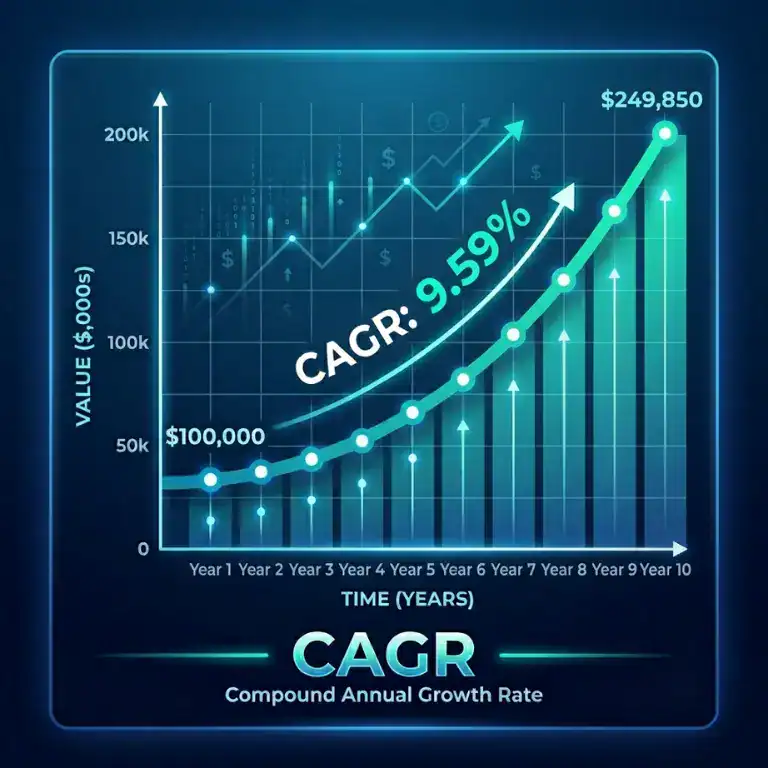
Suppose you invested $100,000
10 years later, your investment was worth, $250,000
Your total return would be 150%
However, your CAGR would be 9.59%
This means that your investment effectively grew at an annualized rate of 9.59% per year over the 10 year period. Feel free to scroll back up and take a look at the CAGR calculator again – try to enter a few different starting and ending values along with various investment periods to see how the number changes.
Related Resources
📈 Learn How CAGR Fits Into Long-Term Investing
How Compounding Actually Works
Understand why compounding is one of the most powerful forces in investing and how small, consistent returns can lead to significant wealth over time.
⏳ Double Your Money Faster
Rule of 72 Explained
Learn a simple mental shortcut for estimating how long it takes an investment to double at a given rate of return.
💰 Investing Regularly vs Investing All At Once
SIP vs Lump Sum Investing
Explore the advantages and trade-offs between investing gradually over time versus deploying capital immediately.
🧮 Estimate Future Portfolio Growth
Investment Growth Calculator
Project how your investments may grow over time based on your starting amount, monthly contributions, and expected annual returns.
References
FAQs
A “good” CAGR depends on the type of investment and the level of risk involved. Historically, broad stock market indexes have delivered annualized returns in the high single digits over long periods. Comparing a CAGR against an appropriate benchmark is often more useful than looking at the number in isolation.
Yes. If an investment loses value over time, the CAGR will be negative. For example, if an investment falls from Rs. 100,000 to Rs. 80,000 over five years, the CAGR would indicate the annualized rate of decline.
No. CAGR assumes a single starting value and a single ending value. If you regularly add money to an investment through monthly contributions or SIPs, other metrics such as XIRR may provide a more accurate picture of performance.
Average returns can sometimes create a misleading impression because they do not account for compounding. CAGR smooths out fluctuations and shows the annualized growth rate required to arrive at the final investment value.
Yes. While commonly used for investments, CAGR can also be used to measure the growth of revenue, profits, customers, website traffic, or other business metrics over time.
Not necessarily. A higher CAGR may be accompanied by significantly higher risk. Investors should consider volatility, drawdowns, diversification, and their investment goals alongside CAGR when evaluating performance.
Total return measures the overall gain or loss over an entire period, while CAGR converts that performance into an annualized growth rate. Two investments can have the same total return but very different CAGR figures if they were held for different lengths of time.
The CAGR Calculator (CAGR) becomes less useful when there are multiple deposits and withdrawals throughout the investment period. In such cases, metrics like XIRR or money-weighted returns may provide a more accurate representation of performance.
Yes. One of CAGR Calculator’s/(CAGR’s) biggest advantages is that it allows investors to compare investments held over different time periods using a common annualized growth rate.
No. The CAGR Calculator (CAGR) only describes past performance. While it can help analyze historical growth, it does not guarantee that an investment will achieve similar returns in the future.
Methodology: The CAGR calculator uses the standard CAGR formula commonly used by investors and financial professionals to annualize investment returns.
Disclaimer: The CAGR calculator provides estimates based on the values you enter and should be used as a decision-support tool rather than a guarantee of future marketing performance. Actual results may vary depending on campaign execution, attribution models and market conditions.